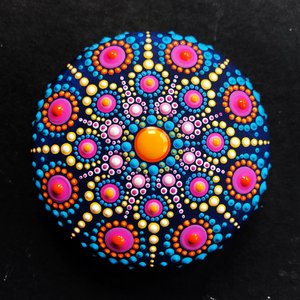
You sat down with your dotting tool, your paints, your carefully sketched grid. You made every dot with intention. And then it dried - and something was off.
The dots or swooshes looked different from last time. Some flatter than you wanted. Some with a rough surface instead of that clean, smooth finish. The colors look slightly dull. The piece doesn't quite have the quality you saw in your head.
Sound familiar?
After ten years of dot art and testing more products than I care to admit, I can tell you that this is the most common frustration I hear from dot artists at every level. And in almost every case, the cause is the same thing:
It's not your technique. It's your paint consistency.
Specifically - it's the fact that most dot artists don't yet know how to control their paint consistency. And that's where acrylic mediums come in.
Paint consistency: the most overlooked skill in dot art
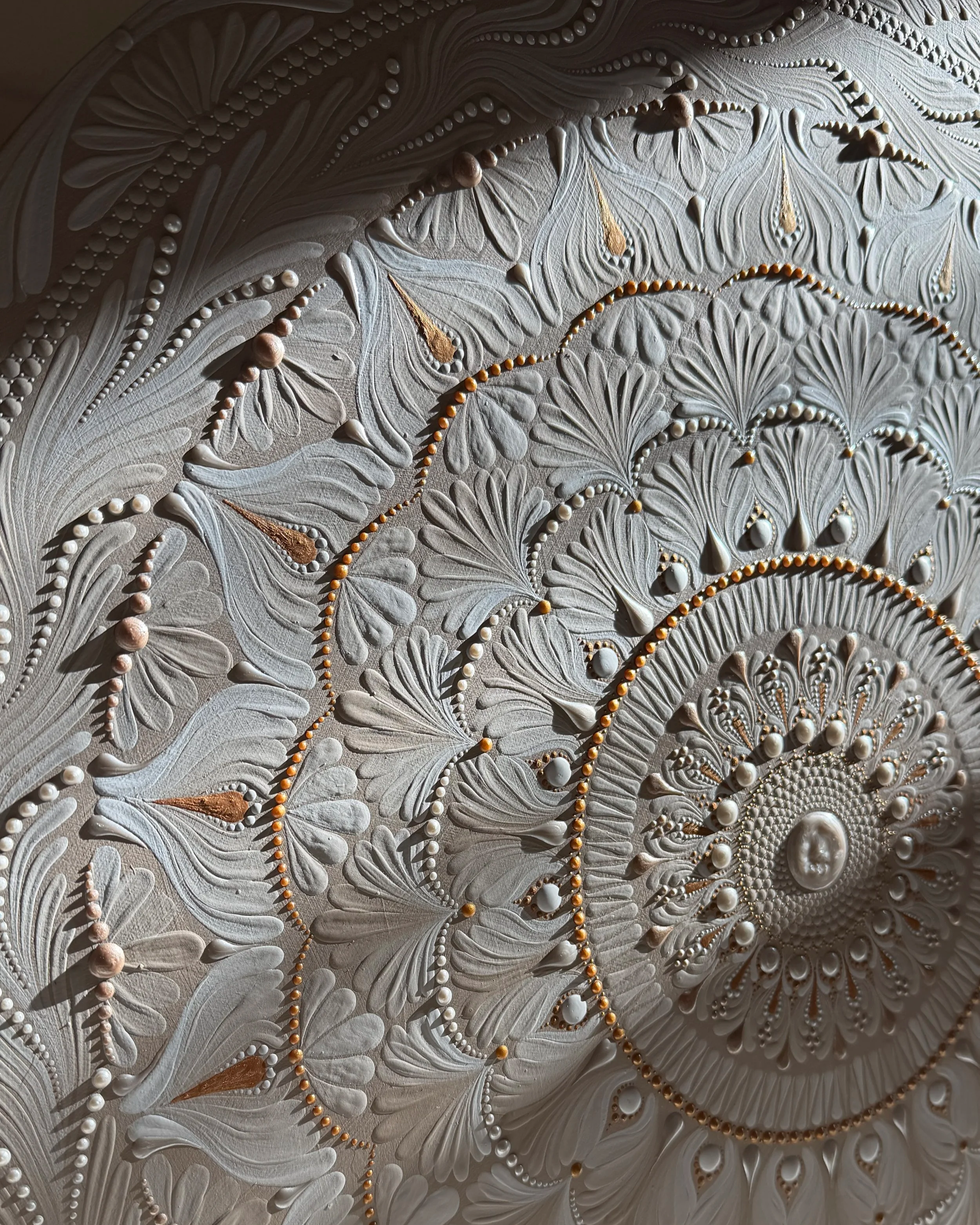
Most dot art tutorials focus on tools, patterns, and color choices. Very few talk about what's actually happening inside your paint - and how much that affects your finished result.
how much that affects your finished result. Here's the thing: acrylic paint straight from the bottle was not designed for dot art. It was designed for brushwork - spread across a surface, blended, layered in strokes. When you load it onto a dotting tool and place it as a single precise point, you're asking it to do something it wasn't formulated to do on its own.
The result? Inconsistency. Some dots hold their shape, some spread. Some dry with a subtle peak, some dry flat. On a humid day it behaves one way, on a dry day another. Different brands behave completely differently even at the same price point.
This is why two dot artists using the same pattern and the same colors can produce completely different-looking work. It's not talent. It's paint behavior.
Acrylic mediums are what you mix into your paint to take back control of that behavior. And once you understand them, your results stop being accidental.
The 4 things acrylic mediums actually change in your paint
Think of your paint as having four dials you can turn - body, flow, sheen, and dry time. Mediums are what let you adjust each one.
Body - how thick and dimensional your dots are
Body refers to how much substance and weight your paint has. High-body paint holds a peak when you place a dot - it stays rounded and dimensional as it dries. Low-body paint spreads and flattens.
Gel mediums add body without being too stiff to work with. Mix a right gel or gels (yes, I often mix multiple gels) into thinner craft paint and you can achieve raised, puffy dots that catch the light beautifully - even with a $1 bottle of DecoArt Americana. The gel is doing the work, not the paint brand.
Flow - how smoothly paint releases from your tool
Flow is about how your paint moves - whether it releases cleanly from the tip of your dotting tool or drags, strings, or leaves ragged edges. Thick, sticky paint has poor flow. Fluid mediums improve it without making your paint watery or weak.
If your dots have irregular edges, or your paint feels like it's pulling rather than releasing, a small amount of right fluid medium is usually the fix.
Sheen - the final finish of your dots
Sheen is what your dots look like when they're fully dry - glassy and reflective, soft and matte, or somewhere in between. This is controlled both by the medium you mix into your paint and by the finishing varnish you apply at the end.
Gloss mediums make colors more vibrant and give that polished, lacquered look. Matte mediums create a soft, velvety finish. Mixing the two gives you satin. Knowing how to combine them is one of the most powerful things you can learn.
Dry time - how long you have to work
Standard acrylic paint dries quickly - sometimes too quickly when you're placing many dots close together. Slow-dry additives extend your working time so nearby dots don't start to set before you've finished the section. A tiny amount goes a very long way - this is the one medium where less is always more, helpful when working outside on a warm day!
What $1 paint and $20 paint have in common (more than you think)
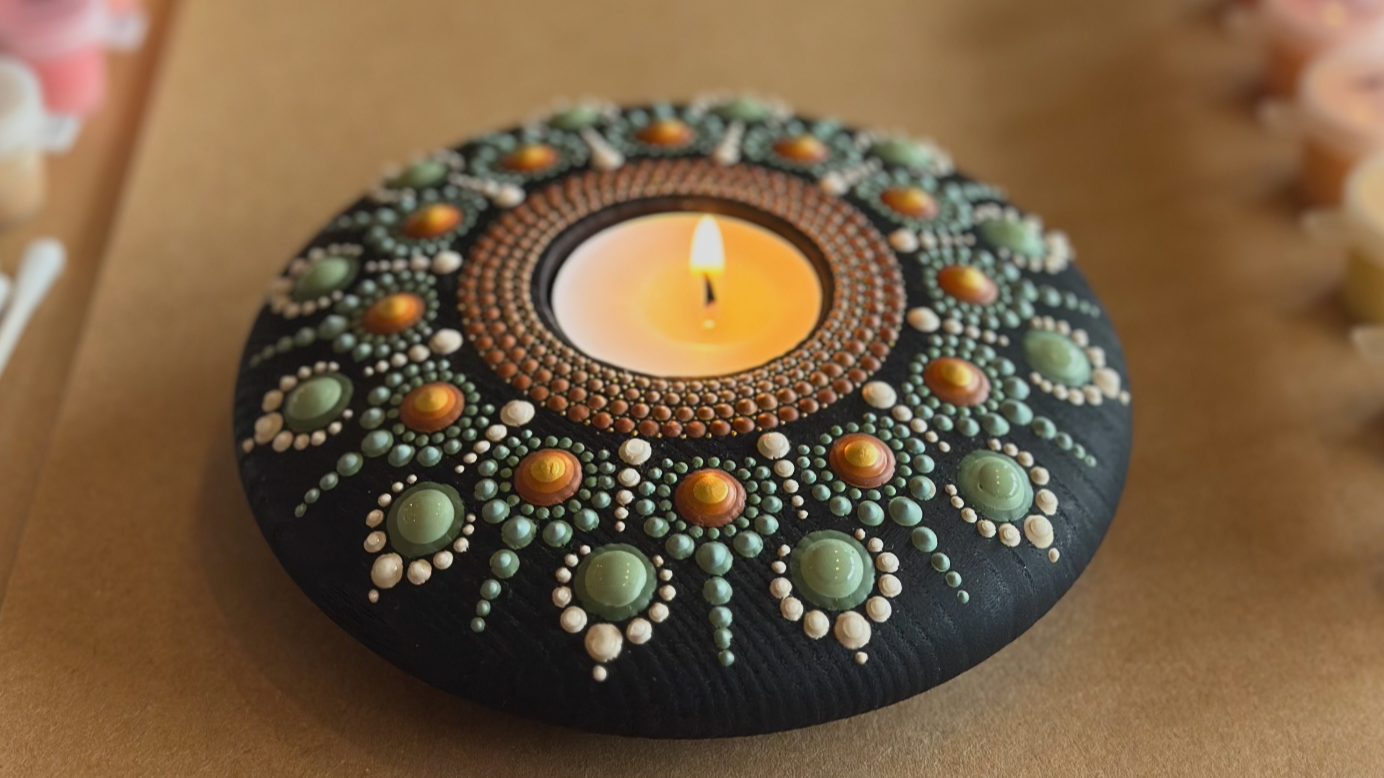
One of the most liberating things I've learned across more than a decade of dot art is this: the price of your paint matters far less than what you add to it.
I use DecoArt Americana regularly - it costs around $1-2 a bottle (OK, might be $3 these days) and is available at almost any craft store. I also use higher-end artist acrylics. And with the right medium at the right ratio, both can produce dots that are indistinguishable in quality.
The paint is the color. The medium is what makes it behave.
I learned this the long way. Years ago, I used to sell custom-formulated dot art paints through my Etsy shop - small batches made by a family operation that specialized in art materials. Those paints were extraordinary. They had a consistency and luminosity that regular paint simply didn't have. People who ordered them always asked what made them so different.
The answer, I later discovered, was marble dust.
Actual marble dust mixed into the paint. It gave the dots a subtle density, a texture, and a way of catching the light that felt almost alive. It was chemistry - very specific, very intentional chemistry, sadly this trick won’t work at home lab.
When I could no longer source those paints, I spent two years figuring out how to recreate that quality. I tested 47 different mediums, gels, pastes, and additives. I made mistakes. I ruined pieces. I developed very strong opinions about which products do what they promise and which ones don't.
What I found is that while you're not going to add marble dust to your paint at home, specific combinations of acrylic gels and mediums can get you remarkably close to that quality - with any paint you already have. The density, the way dots hold their shape, the finish - all of it is achievable.
You don't need to spend more on paint. You need to understand what to add to it.
5 dot art problems acrylic mediums can fix
Most dot art frustrations are medium problems in disguise. Here are the five most common - and what's actually causing them.
1. Your dots spread and lose their round shape
Cause: The paint is too fluid or thin to hold a dome when placed. This is very common with student-grade and craft acrylics straight from the bottle.
Fix: Add a gel medium to increase body. Start with a small amount - and test on a scrap surface. Your dots should hold a clean round shape and dry with a subtle lift rather than spreading flat.
2. Your dots have ragged or uneven edges
Cause: Poor flow - the paint is dragging from the tool rather than releasing cleanly. Often caused by paint that's too thick and sticky, or a tool that isn't quite the right size for the paint consistency you're using.
Fix: A small amount of fluid medium improves flow significantly without weakening the paint. A few drops per tablespoon of paint is usually enough. Mix gently to avoid introducing air bubbles.
3. Your finish looks cloudy or milky after varnishing
Cause: The most common reason is applying varnish before the paint has fully cured - not just dry to the touch, but fully cured through all the layers. This traps moisture and creates cloudiness.
Fix: Wait until your paint has fully cured before varnishing. Depending on thickness, humidity, and the mediums used, full curing can take anywhere from 24 hours to up to 3 weeks. When in doubt, wait longer. Apply varnish in thin coats rather than one thick layer. If the cloudiness is already there, in some cases a second thin gloss coat applied after the first has fully dried can improve it.
4. Your surface is still tacky long after finishing
Cause: Almost always an additive issue - specifically too much slow-dry additive or water. These products need to be used in very small amounts. Too much and the paint may never fully cure.
Fix: Going forward, start with the minimum amount - a few drops per tablespoon of paint - and only add more if you genuinely need the extra working time. For an already-tacky piece, patience is the main option. Keep it in a warm, dry space and allow more time - full curing can take anywhere from a day to up to 3 weeks depending on the mediums used, the thickness of your dots, and your environment. This is also a good reminder never to rush to varnish a piece just because it feels dry on the surface.
5. Your colors look dull or flat when dry
Cause: Acrylic paint naturally dries slightly darker and less vibrant than it looks wet. A matte finish amplifies this effect because it scatters light rather than reflecting it.
Fix: Add a small amount of gloss medium to your paint mix. Gloss keeps colors more true-to-wet as they dry and adds depth. If you want a matte final finish, apply gloss medium in the paint mix for color depth, then finish the sealed piece with a matte topcoat over the dried gloss. You get the color richness of gloss with the soft look of matte.
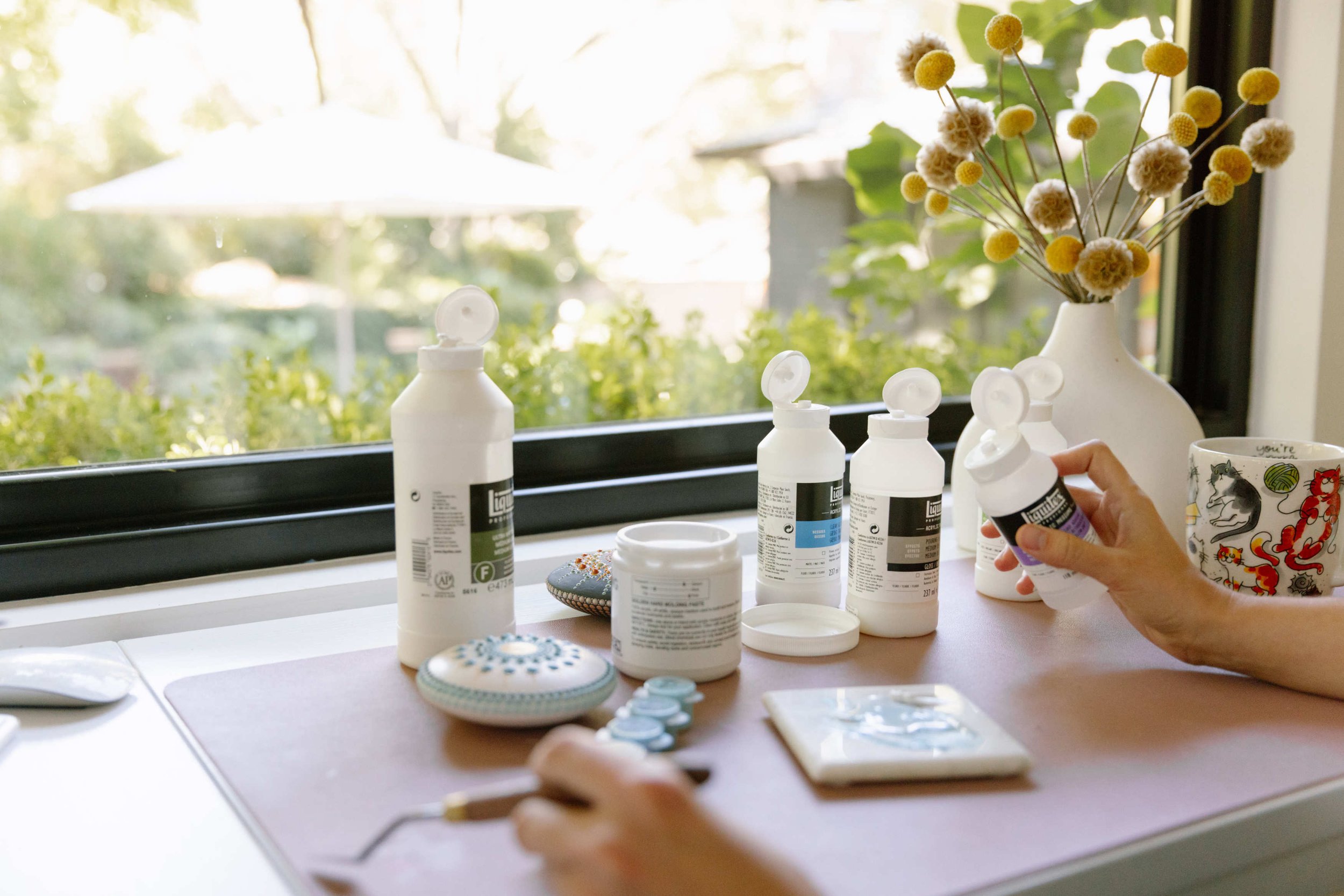
How to start with mediums today - without overwhelming yourself
If you've never used a medium before, the most common mistake is buying five products at once and trying to experiment with all of them at the same time. It's a fast route to confusion.
Start with one. A gloss gel is the most versatile entry point for dot art - it adds just enough body to help craft paint hold its shape, gives dots a beautiful finish, and is forgiving enough that small ratio variations won't ruin your piece.
Mix a small amount into your paint - start with roughly 1 part gel to 3-4 parts paint - and test a few dots on a piece of paper. Watch how they hold their shape. Watch how they look when they dry. That observation process is how you build real understanding, not just following a recipe someone else wrote.
From there, add one medium at a time. Give each one a few practice sessions before introducing the next. Within a few weeks you'll have working knowledge of 3-4 mediums - and your results will have improved dramatically.
And if you want a complete, structured path through all of this - with specific product recommendations, tested ratios, troubleshooting for every scenario, and a full buy/skip list of 47 mediums I've tested specifically for dot art - that's exactly what the Acrylic Mediums Course covers.
Learn how to make your paint behave. After two years of testing every acrylic medium out there, I’ll show you what’s worth buying (and what’s not), how each one changes your paint’s texture, shine, and flow, and how to use them to create smooth dots, 3D effects, and perfect finishes.
Questions about a specific medium or a problem I haven't covered here? Drop a comment below or email me at hello@dotsbylina.com - I read every one.
Thank you for dotting with me,
Lina